Select a site alphabetically from the choices shown in the box below. Alternatively, browse sculptural examples using the Forward/Back buttons.
Chapters for this volume, along with copies of original in-text images, are available here.


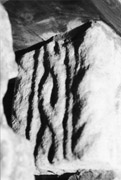
Object type: Part of shaft [1]
Measurements: H. 24 cm (9.4 in); W. 31 > 28 cm (12 > 11 in); D. 20 > 18 cm (7.8 > 7 in)
Stone type: Moderately-sorted, generally coarse-grained, yellow to pale yellowish orange (10YR 7/6–8/4) feldspathic sandstone. Kinderscout Grit or Ashover Grit, Millstone Grit Group, Carboniferous (R.T.)
Plate numbers in printed volume: Ills. 35–7
Corpus volume reference: Vol 13 p. 121-122
(There may be more views or larger images available for this item. Click on the thumbnail image to view.)
A (broad): This face is decorated with a simple, broad, two-strand interlace, although only one register survives with a crossing of diagonal strands at the top. On each side are two thin vertical mouldings with an additional cable edge moulding on the left. On the right is the edge of the pattern on B. There may have been a berry motif in each of the corners formed by the loops of the interlace, but these are quite worn and difficult to discern. Additionally, there may have been a central motif within the loop of the interlace but, again, wear makes this uncertain.
B (narrow): Decorated with an interlace, perhaps better described as a ring chain, but only one register survives. It has triple strands with the interlace arranged as a series of rings intertwined with each other. There is no edge moulding to either side of the face, the pattern wrapping itself around the corners.
C (broad): Obscured, being built into a display next to the porch wall. However, some form of carving can be detected at the back.
D (narrow): This face is decorated with a simple, narrow, two-strand interlace or plait. On each side are thin vertical strands or moulding framed by cable edge mouldings.
This is a small fragment of a cross-shaft and is unusual in this region, with the design on B being a Borre-style ring chain of Scandinavian origin. Perhaps the best example of this pattern–in a form almost identical to that on Bakewell 13–exists on Gosforth 1, Cumberland, which has been dated to the first half of the tenth century (Bailey and Cramp 1988, 103).
The use of a triple-strand interlace on B is also unusual for this region. It did, however, feature on Bakewell 36, now missing (Sidebottom 1994, 223), carved in a type of stone apparently similar to Bakewell 13 but this, of course, can no longer be verified.
The other visible faces are decorated with simple interlace patterns which are common in the region but are, however, concentrated in the Peak District, being absent from the Trent and lower Dove valleys. Other examples are found at Ilam (2 and 4), Alstonefield (1) and Leek (6), all in Staffordshire.
