Select a site alphabetically from the choices shown in the box below. Alternatively, browse sculptural examples using the Forward/Back buttons.
Chapters for this volume, along with copies of original in-text images, are available here.


Object type: Part of shaft [1]
Measurements: H. 41 cm (16 in); W. 30 cm (11.75 in); D. 29 cm (11.4 in)
Stone type: Poorly sorted, white to pale yellow (2.5Y 8/2) feldspathic sandstone. Quartz clasts commonly 0.5–1 mm but with some > 2 mm diameter. Kinderscout Grit or Ashover Grit, Millstone Grit Group, Carboniferous (R.T.)
Plate numbers in printed volume: Ills. 33–4
Corpus volume reference: Vol 13 p. 120-121
(There may be more views or larger images available for this item. Click on the thumbnail image to view.)
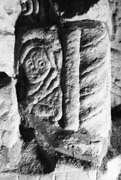
The corner between the two faces bears narrow inner roll mouldings flanking a well-formed, distinctive cable moulding formed by strands with central concave depressions set at an angle.
A (broad): The upper part of the fragment is filled with the remains of a large bird seen in profile, its underside set against the inner roll moulding on the left and its back outlined by a thin plain band extending to the tail on the right. The tip of a wing is visible below the upper break on the right; on the lower left the leg, which terminates in two prominent curved ‘claws’, hangs down along the roll moulding. The body is marked by a series of ‘feathers’ while the wing and tail (separated from the body by a plain curved band), are defined by a series of regular parallel ribs. Below, and extending up from the lower break into the space between the bird’s tail and leg, is the interlaced body of a serpent, its head in profile, its eye deeply drilled and its jaws open, with the upper jaw terminating in a small curl.
B (narrow) and C (broad): Inaccessible
D (narrow): Filled with the upper portion of a forwards-facing figure. The head, framed by a wide curved feature, is outlined by a narrow ‘cap’ of ‘hair’, has deeply drilled eyes that are surrounded by an incised circle, and incised lines mark the nose and mouth. The torso is swathed in drapery: a deeply marked fold crosses the body diagonally from left to right, bifurcating to cross the shoulder.
The distinctive cable moulding with inner mouldings, as well as the style of the figure on D, featuring the double outline round the head, the delineation of the nose and the incised line encircling the deeply drilled eyes, are all features characterising the carvings of Sandbach Market Square 1, Cheshire (Ill. 643), as well as two other fragments at Bakewell (15, 16). Further links with Sandbach Market Square 1 are indicated by the animal ornament on A: the type of leg and ‘claw’ of the bird, and the curl on the upper jaw of the serpent. These details suggest that all three pieces at Bakewell were produced under the strong influence of, if not at, the centre responsible for the production of Sandbach Market Square 1 (Hawkes 2002a, 139-41; Bailey 2010, 99-125). Indeed, as a number of the Bakewell sculptures, some of them formerly in the Bateman collection, came from various sites (see Bakewell 2, p. 113), it is possible that this piece (as well as nos. 15 and 16) came from Sandbach originally, and so is likely to be of the same early ninth-century date as the carvings from that site.
However, despite the strong stylistic links with the Sandbach centre, the subject-matter of Bakewell 12 is not replicated in the extant material there. The curved moulding enclosing the figure on D, and the drapery swathing the torso, indicate that it can be interpreted as Lazarus emerging from the tomb—sometimes denoted simply as a cavity or portal surrounding the resurrected figure (Schiller 1971a, figs. 564-5). The prominently open eyes can also be understood in this light as it is one of the features discussed in exegetical accounts of the subject, particularly those, like Augustine’s commentary on John, which sought to elucidate Lazarus’ resurrection as symbolic of the Christian who, through confession, is released from the bonds of sin by Christ’s intervention, and so wakes into the light of the living world from the darkness of death (Hawkes 2003c, 358). If the figure can be identified as Lazarus, it would provide yet another version of the subject found elsewhere in Anglo-Saxon sculpture of late eighth- and early ninth-century date, in contexts where the Ministry of Christ was used to focus attention on the sacraments and rites of the Church at a time when the gospel account of the event formed the reading of the fourth week in Lent, the week dominated by ceremonies for the catachumenate (Hawkes 2003c).
The remains of the serpent and bird, which can probably be understood to represent an eagle, is a scheme not commonly found in the art of Anglo-Saxon England–nor that of the rest of the Insular world–although it does survive on the late eighth- / early ninth-century cross at Keills in Knapdale (Mac Lean 1986), and was reproduced in a liturgical context on the later eighth-century paten from Derrynaflan, Co. Tipperary (Ryan 1997, 248-50). Here, the iconographic significance of the creatures has been understood in the light of an apocryphal prayer attributed to John the Evangelist, which is preserved in Insular (largely early Hiberno-Latin and Old Irish) contexts, including the late eighth-century Martyrology of Oengus (Stokes 1905). This, unusually in the context of early Christian art, associates the eagle with the Evangelist, rather than Christ (Wittkower 1938-9, 313-18). However, this ‘ingenious interpretation’ (Ryan 1997, 250) of the eagle tends to be invoked to explain why Insular versions of the serpent-and-eagle scheme do not depict the two in combat: the attitude generally featured in Christian art where they illustrate the Pseudo-Ambrosian story of the serpent consumed by the eagle, a narrative invoked as a simile for Christ’s destruction of death (PL 17, 695). This story, however, is not commonly invoked in Christian exegesis, despite the ubiquitous nature of the eagle and serpent in combat in the art of early medieval Europe (beyond the Insular world). More popular was the understanding of the eagle as a symbol of rejuvenation through baptism and penance–in commentaries on Psalm 103:5, such as those by Augustine, Ambrose and Cassiodorus, all of which were known in Anglo-Saxon England. Alternatively, it was considered in the light of Deuteronomy 32:11 as a symbol of unshakeable faith in Christ (e.g. Ambrose Hexameron, PL 14, 231). Visual expressions of these ideas, however, generally take the form of an eagle on its own.
The Insular motif of the eagle-and-serpent could thus be explained as signifying Christ and death, the absence of any combat between the two being indicative of Christ triumphant over death–as is illustrated (figurally) by the well-established iconography of Christ standing over beasts that include a serpent (see Chesterton 1, Staffordshire, Ill. 533). While this may be the case, the scheme at Bakewell remains unclear as a signifier of the salvific themes of Christ’s triumph, especially given the more widespread understanding of the eagle as a symbol of the Christian life. Given that Insular versions of the eagle-and-serpent illustrate them in close conjunction, but not in combat, it is likely that they were intended, separately, to convey related ideas. Rather than seeking to explain them as misunderstood representations of the eagle and serpent in combat, or as somewhat unsatisfactory symbolic representations of Christ triumphant over death, it may be that they were intended to be regarded as separate symbolic entities.
Considered in this way, the serpent has traditionally been explained in the scholarship as symbolising repentance or baptism because it sloughs off its skin. However, Meyer (2005) has demonstrated that this is not an interpretation of the creature found in biblical, exegetical or liturgical literature of the early Christian or early medieval world. Rather, the predominant theme was the Augustinian tradition of the serpent as a symbol of the wise man who (based on Matthew 10:16), lives his life in faith in Christ’s salvation (Hawkes 2005, 269-70). Regarded in this light the serpent bears a set of symbolic references closely related to the Ambrosian tradition that regarded the eagle as symbolising faith in Christ.
Thus, if the two creatures at Bakewell are considered as complementary, they refer to the new life in Christ gained through penance, and the Christian living his life wisely in faith in Christ. Understood in this way, the eagle and serpent would complement the symbolic references of the potential Lazarus scene on A. While this explanation must remain tentative given the fragmentary nature of the carvings, their relationship with the sculpture at Sandbach does suggest a date consistent with the production of the monuments there.
