Select a site alphabetically from the choices shown in the box below. Alternatively, browse sculptural examples using the Forward/Back buttons.
Chapters for this volume, along with copies of original in-text images, are available here.


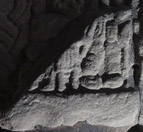
Object type: Fragment [1]
Measurements: H. 35 cm (13.75 in); W. 41 > 11 cm (16 > 4.3 in); D. 18 cm (7 in) max.
Stone type: Well-sorted, fine-grained pale yellowish brown (10YR 7/3) feldspathic sandstone with occasional mica flakes. Millstone Grit Group, Carboniferous (R.T.)
Plate numbers in printed volume: Ills. 31–2
Corpus volume reference: Vol 13 p. 118-119
(There may be more views or larger images available for this item. Click on the thumbnail image to view.)
A (broad): The decoration consists of a crowded figural group bounded on the lower edge by a wide flat moulding. By the break on the far left are the remains of the bare legs and feet of a standing figure, with that on the right being turned to the right. Next to this figure is the lower portion of another figure wearing a short robe whose feet are also turned to the right. The robe, with its hem visible behind the legs, is carved with a series of parallel ribbed folds. Below the upper break the right arm crosses the body and holds out, to the right, a short rod grasped half way along its length. On the far right is a swathed full-length figure whose head, with a ‘cap’ of short hair, faces forwards; although worn, the nose, cheeks and chin are well modelled. Between this figure and that with the rod is another figure hanging upside down, the head, with short hair, is tucked in towards the hem of the robe worn by the rod-bearing figure, and the feet curve over the head of the swathed figure. Beneath the head, a further head lies on its side, its chin disposed in front of the leg and foot of the rod-bearing figure; it too has short hair and well-modelled features, while the eyes are drilled. To the right and at the foot of the swathed figure are the remains of a piece of carving, the same size and shape as the head next to it; although worn, it too seems to bear the modelled features of a face. To the right of the swathed figure by the break in the stone are what appear to be the remains of a further standing figure. The chin and lower part of the face survive below the upper break, and a large flat circular object overlies the torso.
B (narrow) and C (broad): Inaccessible
D (narrow): Broken
The figural style of this group of figures, characterised by a ‘doll-like’ appearance, the wig of short hair crossing the head, well-modelled faces, and the heavy parallel ribbing of the clothing, are all features distinguishing the figural carving of Wirksworth 5 (Ills. 446-55) and suggest Bakewell 11 can be associated with the centre responsible for that monument (see Chapters III and VI).
Although fragmentary, the remains are sufficient to indicate that the group formed part of a scene involving a massacre. The two decapitated heads indicate dismemberment, while the ‘rod’ held by the figure on the left is probably best understood as a sword, and the circular feature overlying the torso of the figure on the far right, as a shield. In the light of this Bailey (1990, 2) explained the scene as the Massacre of the Innocents. This event was featured with considerable frequency in early Christian art, from the fifth century onwards, having been instituted at that time as a Feast of the Church in the octave of Christmas, and known as such in the Anglo-Saxon world by the eighth century, with a lengthy hymn being composed by Bede for the occasion (In Natali Innocentium; Hurst and Fraipont 1955, 412-13).
The earliest versions of the Massacre demonstrate the existence of two different iconographic types: one illustrated the infants being dashed to pieces; the other showed them being dispatched with weapons. Regardless of the type of action undertaken by the soldiers, both versions show them armed and the mothers with their hair hanging loose in the traditional expression of extreme grief and mourning. The presence of the sword and shield on Bakewell 11, along with the decapitated heads, would thus seem to support Bailey’s explanation, while the inclusion of a figure hanging upside down between the sword- and shield-bearing soldiers is paralleled in versions where one of the infants is held upside-down by a sword-wielding soldier. In this context the swathed figure on the right can be understood as a child in its swaddling clothes. No figures identifiable as the mothers are included on no. 11 but, as much of the scene has been lost, their absence does not mean they were not originally included — on the left.
The apparently large size of the swathed and upturned figures might argue against this interpretation, but the proportions of the sword-wielding soldier suggest he was originally much larger than them, as was the soldier with the shield. Furthermore, on Wirksworth 5 the infant Christ is depicted as a ‘small adult’ rather than a diminutive infant (scene viii, Ill. 455). Overall, therefore, it is likely that Bakewell 11 illustrates the Massacre of the Innocents, and probably depicted the iconographic version showing the soldiers dispatching the children with their weapons.
As this iconographic image was so widespread in early Christian art there is little indication of where the model lying behind the Bakewell version may have originated, although the inclusion of the upside-down child in a ‘sword type’ of Massacre, may suggest a source of early Eastern origin illustrating a relatively rare version of this iconographic type, like that featured in the sixth-century Syriac Rabula Gospels (Schiller 1971a, fig. 299). Normally, the child held upside-down forms part of scenes illustrating the infants being dashed to pieces, while the ‘sword type’ depicts the children upright or lying down.
The possibly early Eastern nature of the original model type is that lying behind most of the scenes on Wirksworth 5, further suggesting a close relationship between the two pieces, and indicating that a date close to Wirksworth 5 seems likely for Bakewell 11.
