Select a site alphabetically from the choices shown in the box below. Alternatively, browse sculptural examples using the Forward/Back buttons.
Chapters for this volume, along with copies of original in-text images, are available here.


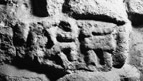
Object type: Part of shaft [1]
Measurements: H. 13 cm (5 in); W. 28 cm (11 in); D. unknown
Stone type: Moderately-sorted, generally coarse-grained, very pale orange (10YR 8/3) feldspathic sandstone. Kinderscout Grit or Ashover Grit, Millstone Grit Group, Carboniferous (R.T.)
Plate numbers in printed volume: Ills. 29–30
Corpus volume reference: Vol 13 p. 117-118
(There may be more views or larger images available for this item. Click on the thumbnail image to view.)
A (broad): The remains of vertical roll mouldings survive on the right and upper left of the stone. Contained within these are the remains of a well modelled but unidentifiable knot-work pattern on the left, and the remains of the lower half of a figure with bare legs wearing a short tunic on the right; the feet are turned to the centre. One arm, bent sharply at the elbow, is visible crossing the body below the upper break; a small square object is held to the left. Chisel marks demarking the arm are still visible.
B and D (narrow) and C (broad): Inaccessible
Diminutive profile figures holding a small book across the body feature more than once in the carved stone sculpture of this region. Indeed, a second such figure is preserved on Bakewell 29, although in this case the book is held at an angle and the figure wears a full-length robe as opposed to the shorter garment worn by the figure on no. 10. A similar figure, also wearing a long robe, but holding the book across the body at waist-height, is found on Alstonefield 5, in Staffordshire (Ills. 69, 491).
In all three instances, the figures are depicted on their own. Bakewell 10 is bounded by vertical angle mouldings on both sides, meaning no further figures were included, while that on Bakewell 29 is framed on both sides by inner and outer mouldings, and the Alstonefield figure is framed by inner and outer mouldings on the right, the vestiges of the inner moulding on the left and by a horizontal moulding below. The fragmentary nature of the pieces, while preserving these settings, means that it is not possible to determine whether the figures were part of a scheme involving a series of such figures set one above the other along the length of the monument, or were portrayed as individuals.
If part of a series, it would be tempting to regard them as part of an apostolic scheme, as seems to be preserved elsewhere —at Collingham (1) in west Yorkshire, for instance (Coatsworth 2008, 117-19). On the other hand, if they were portrayed individually, it implies that the book-bearing figures are best understood as clerics. In either case, given the association of the role of the priest with the apostolic mission of the Church found in the exegetical and homiletic literature, these figures must have been part of a programme concerned to display the Church and its pastoral role in the region.
With this in mind, perhaps the most distinctive iconographic element is the small size of the books. Many of the figures on the crosses in Sandbach Market Square, Cheshire, bear similar attributes (Bailey 2010, 99-125), and a number of sculptures in the region (Bakewell 14, Hope 1, Checkley 1-2, Ilam Estate 1) bear the possible signs of iconographic and stylistic dependence on the Sandbach monuments; this may represent another such example of this phenomenon, whereby details displayed with some prominence on the monuments at Sandbach, produced in the first half of the ninth century, provided inspiration for sculptures subsequently produced elsewhere at different dates.
