Select a site alphabetically from the choices shown in the box below. Alternatively, browse sculptural examples using the Forward/Back buttons.
Chapters for this volume, along with copies of original in-text images, are available here.


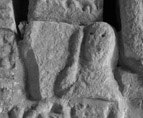
Object type: Part of shaft [1]
Measurements: H. 21 cm (8.25 in); W. 24 cm (9.5 in); D. unknown
Stone type: Moderately-sorted, generally coarse-grained very pale orange (10YR 8/3) feldspathic sandstone. Kinderscout Grit or Ashover Grit, Millstone Grit Group, Carboniferous (R.T.)
Plate numbers in printed volume: Ills. 27–8
Corpus volume reference: Vol 13 p. 116-117
(There may be more views or larger images available for this item. Click on the thumbnail image to view.)
A (broad): The fragmentary remains of a vertical feature survive on the far left. Next to this, the surface of the stone, although plain, is deeply cut back and dressed. To the right are the head and shoulders of a veiled figure, three-quarters turned to the left, who holds up a short rod; the face is well modelled with deeply drilled eyes, a long nose and rounded cheeks and chin. The head and shoulders are swathed in horizontal folds of drapery.
B (narrow) and C (broad): Inaccessible
D (narrow): Broken
The remains of the figural carving were regarded by Routh (1937a, 11; 1937b, 12-13), as resembling, stylistically, that of Bakewell 15, a piece closely related to the monuments at Sandbach, Cheshire (see further Bakewell 12, 15 and 16). With the absence from no. 9 of the double outline round the head, and the incised line encircling the eye–features characteristic of the Sandbach carvings (Bailey 2010, 99-125)–the proposed relationship is not convincing. On the other hand, the facial features are distinctive of Wirksworth 5 (Ills. 444-53): namely, the deeply drilled eye, the well-formed nose, rounded cheeks and chin, and the well-defined mouth. These, along with the veil that seems to envelop the head and the swathes of clothing traversing the upper part of the body, are all details replicated on Wirksworth 5, while some also feature on Bakewell 11; they strongly suggest a close relationship and may well indicate a shared centre of production.
The identity of the Bakewell figure is unclear given its fragmentary nature. While the veil would seem to suggest a female figure, the short staff or wand is an attribute more commonly associated with Christ in early Christian images of his miracles. The empty space next to the figure also needs to be taken into consideration, as does the vertical feature to the left. If this represents the remains of a frame, it would imply that any feature associated with the wand-wielding figure would have been situated at its feet. If this were the case, it might indicate that the scene could be interpreted as a miracle scene, such as that of the Loaves and Fishes, or the Wedding at Cana, both of which survive in early Christian contexts with Christ holding a wand. In such images, however, the wand is pointed down at the baskets and wine casks, and Christ is not depicted as veiled.
If, on the other hand, the vertical feature represents a further element of the scene, it could represent the remains of an attribute, such as a staff, held by a second figure, or even an architectural feature. This latter possibility might suggest the presence of an image depicting Christ Raising Lazarus (with the vertical element being part of the tomb). Here, however, the veiled nature of the figure would argue against such an identification; while Christ is featured holding a wand upraised in fourth-century versions of this scene, nowhere is he veiled.
This detail, might, of course, be understood to identify the figure as female; in an Anglo-Saxon context this might most reasonably be expected to be the Virgin (Hawkes 2003c, 352-4, 365-6). However, it is difficult to interpret the scheme, and particularly the wand held by the figure, as illustrating an event from the life of the Virgin known to have been circulating in early medieval Christian art. The only other type of figure illustrated as being veiled in early Christian art, is the priest of the Temple; Simeon, for example, is figured in this way on Wirksworth 5 in the scene of the Presentation of Christ (Ill. 453). Even in this context however, there are no obvious examples of a priest holding a wand.
Without further identifiable elements, therefore, the identity of the scene must remain unclear. It does, nevertheless, serve as a reminder of the potential range of narrative scenes once present in the corpus of carved stone sculpture in this region, and in Anglo-Saxon England more widely, beyond the narrow range currently identified (Chapter VI; Hawkes 2003c, 352-4, 367-8). The relationship between the figural style and that of Wirksworth 5 further indicates a dating for the piece not too far removed from that of the Wirksworth stone.
