Select a site alphabetically from the choices shown in the box below. Alternatively, browse sculptural examples using the Forward/Back buttons.
Chapters for this volume, along with copies of original in-text images, are available here.


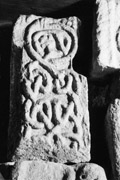
Object type: Part of a shaft and possibly part of cross-head [1]
Measurements: H. 42.5 cm (16.7 in); W. 22 cm (8.7 in); D. 19 cm (7.5 in)
Stone type: Poorly sorted, very pale orange (10YR 8/4) feldspathic sandstone. Quartz clasts up to 1 mm occur. Kinderscout Grit or Ashover Grit, Millstone Grit Group, Carboniferous (R.T.)
Plate numbers in printed volume: Ill. 26
Corpus volume reference: Vol 13 p. 116
(There may be more views or larger images available for this item. Click on the thumbnail image to view.)
A (broad): This face is decorated on its lower two-thirds by a mirrored complete interlace pattern comprising asymmetrical loops. It is truncated at the bottom where the stone has been broken. At the top two strands of the interlace extend to form a central spiral scroll, one of which becomes thicker and a thick node divides the strand above the scroll. The other strand forms the scroll itself which includes a v-bend, returning the strand. In the centre is a round cluster of six or seven berries. Above the scroll, to the right of the node are three berries with a strand of interlace to its right. The pattern is truncated where the stone has been broken. To the right of the lower part of the decoration is a plain area which may have once been an edge moulding, since the pattern to its left appears complete. The left-hand edge is damaged.
B (narrow): No decoration survives on this face.
C (broad): Inaccessible
D (narrow): Although this face appears to have been decorated, it is badly broken with patches of mortar covering the face, to an extent that renders it indecipherable.
The shape of the surviving portion of shaft, along with the central position of the plant-scroll suggests that the top probably formed the centre of a cross-head, although this is uncertain. It is one of several pieces at Bakewell which feature the stylised plant-scroll motif (e.g. Bakewell 1, 2 and 4), but in this instance, the scroll merges into a mirrored interlace pattern, a phenomenon found elsewhere at Sandbach in Cheshire (Market Place 1: Bailey 2010, 105–6), but the loose and attenuated nature of the interlace in this instance may indicate a tenth-century date.
