Select a site alphabetically from the choices shown in the box below. Alternatively, browse sculptural examples using the Forward/Back buttons.
Chapters for this volume, along with copies of original in-text images, are available here.


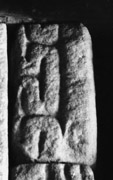
Object type: Part of shaft [1]
Measurements: H. 31 cm (12.3 in); W. 16 cm (6.25 in); D. 16 < 20 cm (6.25 < 8 in)
Stone type: Fairly well-sorted greyish orange pink (5YR 7/3) feldspathic sandstone. Kinderscout Grit or Ashover Grit, Millstone Grit Group, Carboniferous (R.T.)
Plate numbers in printed volume: Ills. 19–20
Corpus volume reference: Vol 13 p. 114
(There may be more views or larger images available for this item. Click on the thumbnail image to view.)
A (broad): This face is decorated with a thick-stranded key pattern of which only the right-hand side remains, that to the left having been broken away. To the right is a broad, apparently roll edge moulding.
B (narrow): Decorated with a fragmentary pattern that appears to be a spiral plant-scroll, although only the left-hand portion of part of one register is visible, the rest being broken away on the right. The centre of the spiral appears to terminate in berries although its fragmentary nature makes this uncertain. To the right, above the spiral, appears to be a triple leaf pattern, although wear also makes this uncertain.
C (broad) and D (narrow): Broken away
Probably part of a cross-shaft, the key pattern on A, derived ultimately from classical art, is found on several pieces in the region, on both round and rectangular-sectioned shafts. The design is often accompanied by simple interlace patterns and sometimes a stylised plant scroll (as, for example, at Stoke on Trent 1 or Ilam 2 in Staffordshire). Such monuments appear to be copies, or stylised variations, of decoration found on the more elaborate Bakewell crosses, such as Bakewell 1 or 31 and are often regarded as later monuments.
