Select a site alphabetically from the choices shown in the box below. Alternatively, browse sculptural examples using the Forward/Back buttons.
Chapters for this volume, along with copies of original in-text images, are available here.


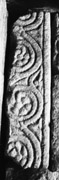
Object type: Part of shaft [1]
Measurements: H. 70 cm (27.56 in); W. 17.5 cm (7 in); D. 15 cm (6 in)
Stone type: Moderately sorted, clast-supported, fine to medium-grained, pale yellowish (10YR 8/6) feldspathic sandstone. Grain size varies from 0.2 to 0.5 mm, but most are medium-grained between 0.3 and 0.4 mm. A few flakes of mica are present. Namurian sandstone consistent with low energy facies of Kinderscout Grit and Ashover Grit locally, but more typical of Shale Grit to the north. Millstone Grit Group, Carboniferous (R.T. & C.R.B.)
Plate numbers in printed volume: Ills. 17–18
Corpus volume reference: Vol 13 p. 113-114
(There may be more views or larger images available for this item. Click on the thumbnail image to view.)
Alterations to All Saints church in 1841–51 involved pulling down the piers of the tower and nave in 1843–6; this revealed numerous carved stone fragments of Anglo-Saxon and later medieval origin which are currently divided between the south porch and north aisle of the church. Cox (1877a, 32), whose writings display considerable antipathy towards the local antiquary and amateur archaeologist, Thomas Bateman, estimated that approximately fifty-five of the stones were removed to Bateman's museum at Lomberdale Hall, leaving sixty-five others to be placed in the south porch and 'four times that number' to be reused in the rebuilding of the church fabric (Marsden 2007, 58–61). However, when the British Archaeological Association visited both the church and Lomberdale Hall in 1852, a year after the renovation work had been completed, only eighteen of the Bakewell stones were recorded in Bateman's collection, with sixty-two remaining in the south porch ((—) 1852, 324). Of the pieces in Bateman's collection, only three seem to have been Anglo-Saxon: nos. 30, 33 and 42 (Bateman 1847b, 303–5; Plumptre 1847, 38–9; Bateman 1855, 185–6; Howarth 1899, iii–iv). There were, however, four other Anglo-Saxon pieces in his collection: the remains of a cross-head purchased after its discovery on Elton Moor (Elton Moor 1: Bateman 1855, 185); two pieces 'requisitioned' from Darley Dale during the restoration work there in 1854 (Darley Dale 1 and 6: Bateman 1861–2, 21–2); and a piece found on Stanton Moor in 1845 and purchased by Bateman (Bateman 1855, 186). Although he does not mention any details of this last stone, Bateman describes it as measuring 13 in (33 cm); this does not coincide with the measurements of any of the stones surviving from his collection, but Bakewell 35 does measure just over 12 in (c. 31–32 cm) suggesting it might be identified as the piece from Stanton.
After Bateman's death in 1876, the family deposited his collection, on loan to the City Corporation, with the Public Museum at Weston Park in Sheffield. Subsequently, in 1893, when they arranged for the sale of the collection, all objects collected from Yorkshire by Thomas Bateman and his father, were purchased by the Corporation. This included Bakewell 33, 35 and 40; and although only Bakewell 33 is listed in the 1899 Museum catalogue (Howarth 1899, 253), it, along with Bakewell 35 and 40 are still in the Museum. Bakewell 30 and Elton Moor 1 were subsequently returned to the church, where Bakewell 30 remains; Elton Moor 1 is missing.
A (broad): This face is decorated with a spiral plant-scroll, the scroll having two visible strands surrounding central clusters of six or seven berries as a rosette. Three registers of the plant-scroll are visible with a truncated forth at the top. To the right triangular three-leaf patterns extend between each scroll; that in the centre is slightly different in that a spur extends from the main stem which appears to support the leaf pattern below. On the right-hand edge is a flat edge moulding.
B (narrow): Almost two-thirds of this face is obscured by the adjacent stone built into the porch display. The portion that is visible is badly damaged. One curved strand can be discerned and a small interlacing at the top with a strand crossing it diagonally at the bottom left; the central ornamentation is damaged and missing. It is not clear whether the scheme formed a simple interlace pattern or a plant-scroll, as on A.
C (broad): Obscured and inaccessible.
D (narrow): Obscured but appears to be broken away
This piece is one of a number which displays a plant-scroll design. It appears to be a simplified version of that found on Bakewell 1, especially on 1B. It is also used on Bakewell 7, 17 and 27; on 17A it takes a stylised form which is found elsewhere in the region, for example, at Stoke-on-Trent (1) and Leek (6) in Staffordshire, or Brailsford (1) in Derbyshire. The design is sometimes seen as Northumbrian in style, in that it echoes elements on fragments at Hexham, Northumberland (no. 3D: Cramp 1984, pl. 175.926-7). Ultimately, such motifs owe their legacy to the art of late antiquity and it may be that the proximity of Hadrian’s Wall and its Roman infrastructure helped inspire the plant-scroll variations in Northumbria (although see Hawkes 2003b). If the pattern on Bakewell 2B was an interlace it is a motif ubiquitous to the region.
