Select a site alphabetically from the choices shown in the box below. Alternatively, browse sculptural examples using the Forward/Back buttons.
Chapters for this volume, along with copies of original in-text images, are available here.


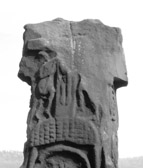
Object type: Cross-shaft and part of -head [1]
Measurements:
Shaft: H. 244 cm (96 in); W. 55 > 50 cm (21.5 > 19.75 in); D. 35 > 32 cm (13.75 > 12.5 in)
Head: W. 65 cm (25.5 in)
Stone type: Generally well-sorted pink (7.5YR 7/4) feldspathic sandstone with quartz clasts of up to 1 mm. Kinderscout Grit or Ashover Grit, Millstone Grit Group, Carboniferous (R.T.)
Plate numbers in printed volume: Ills. 6–15; Fig. 39
Corpus volume reference: Vol 13 p. 105-113
(There may be more views or larger images available for this item. Click on the thumbnail image to view.)
The shaft and cross-arm (of cross-head type A11: Cramp 1991, xvi) are framed on all four sides by plain flat angle mouldings, inset on face A with thinner roll mouldings.
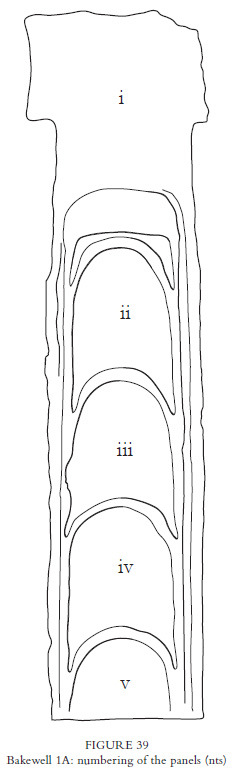
A (broad): The inner mouldings are marked at points along their length by three bands from which spring arches containing the figural panels filling the shaft (see Fig. 39). Above the uppermost arch the vertical inner moulding forms a further arch containing a wide horizontal band cross-hatched by vertical and horizontal incisions; to the left this band extends slightly over the vertical roll moulding. Above, and filling the upper reaches of the shaft and the lower cross-arm, is an incomplete figural scene (i). This consists of the remains of two standing profile figures flanking and facing a central cross, of which the lower vertical arm and the (worn) terminal of the horizontal arm on the left survive; the lower vertical arm contains the bare legs of a figure wearing a short skirt. The figure standing on the right is largely lost in the damage to the stone, and only the bare legs and feet survive, the leg nearest the cross being well modelled and flexed at the knee; the other extends into the spandrel of the arch below. Most of the figure on the left survives below the horizontal cross-arm. His head, with short hair, is tipped slightly back to look up at the cross. His right arm, sharply bent at the elbow, crosses his body to hold the lower part of a staff that extends across his body diagonally up towards the cross; his left arm originally stretched out to hold the upper part of this staff. He wears a short tunic that ends above his knees; his legs, flexed at the knees, are well modelled (Ill. 6). The arched panel (ii) at the top of the shaft, is considerably worn, but contains the remains of two full-length profile figures facing each other and wearing long robes; they stand with their feet on the arch of the panel below. Their heads are slightly tipped back, and their arms, swathed in drapery, extend out towards each other (Ill. 7). Centrally placed in the panel below (iii) are the worn remains of a forwards-facing, short-haired figure wearing a heavily pleated over-garment gathered around him, which falls in regular ribbed folds that cascade in sharp S-shapes on the lower right. This figure appears to grasp a rod with both hands that extends over the left shoulder to terminate in an indeterminate shape (Ill. 8). The contents of the panel below (iv) are very eroded, but seem to consist of a centrally-placed, forwards-facing figure, whose head and shoulders are still visible in deep relief, standing proud of the flat surface of the field of the panel. The body is enveloped in heavy swathes of drapery that terminate immediately above the arch of the lowermost panel. Below and to the left are the remains of a second, diminutive figure whose body appears to have been cut off by the arch below; the head is tipped up at a slight angle. A carved element on the right is too worn to identify (Ill. 9). The partial remains of the lowermost panel (v) consist of the upper portion of a single figure, set slightly to the left; to the right are the remains of an unidentifiable piece of carving (Ill. 9).
B (narrow): In the cross-arm are the weathered remains of a half-length figure clothed in heavy swathes of drapery falling in thick regular pleats. He had short hair and deeply drilled eyes. The worn remains of a rod traverse his body diagonally, to terminate over his shoulder in the right-hand corner of the panel (Ill. 14). The shaft below is filled with a fat-stemmed plant-scroll arranged to form eight tightly scrolled spirals that wind alternately left and right up the length of the shaft with a round cluster of six to eight berries at the centre of each spiral. Triple ridged nodes mark the split between the main and subsidiary spiralling stems, between which emerge a pair of plain pointed leaves. Short branches terminating in long triangular clusters of berries spring from the centre of each spiral to hang down over the outer stem of the spirals and fill the alternate spaces between them.
C (broad): The upper edge curves slightly up on the right, into the cusp of what was the horizontal cross-arm. The carving in the extant vertical (lower) cross-arm consists of a centrally placed horseman moving to the left (Ill. 15). Only his leg is visible, emerging from behind a prominent circular shape that appears to have been decorated in low relief which covers the lower part of the body. The horse’s head hangs down on the right with the bridle visible and the reins passing up over the flank of the near foreleg. Depicted in the gait of a canter, the legs and flanks are well modelled; a long tail hangs down to the rear. Lying horizontally under the horse’s legs and filling the lower portion of the panel, is a thick-stemmed branch that terminates under the forelegs in two wide curved leaves flanking a central bud that emerges from two well-defined nodal bands; worn carving to the left of this indicates that further foliate motifs extended out and up to the left of the horse’s head. Another (short) branch, terminating in a round bud, passes over the main stem and up under the horse’s belly, to end in a small spear-shaped leaf. On the right, a long branch extends upwards to fill the space between the horse’s hindquarters and the vertical frame; two curved tendrils bifurcate from this to the right, terminating in spear-shaped leaves, while a third branch springs up and out to the left, over the horse’s hindquarters.
The shaft below the horizontal moulding separating it from the cross-arm is filled with a plant-scroll composed of three large, tightly scrolled spirals similar to those on B. At the top, the stem curves loosely round to contain a profile quadruped turned to the right (Ill. 15). It has a long snout with jaws open to feed on the worn remains of a cluster of berries that it grasps in its extended forepaw; its hindquarters taper to the left, and a tail, bending up and half-way along its back, terminates in a slight curl. Its hind legs extend to the right under its belly. The cluster of berries on which it feeds branch out from the main stem of the scroll, and the worn remains of another branch hang down beside it on the right, passing over the main stem of the plant to terminate in either another cluster of berries or a spear-shaped leaf. On the left, the main stem continues to curl up and under the body of the quadruped, ending in a spear-shaped leaf beside its hind legs. At the base of the shaft, just above the socket stone, the spiral stem curves over a bow held by the extended arms of a figure now obscured by the socket stone; the head of the arrow is visible passing beyond the curved frame of the bow and into the branch of the scroll above.
D (narrow): The panel formed in the cross-arm is filled by a quatrefoil knot with the connecting strands forming a saltire cross; the under-surface of the cross-arm is plain. The shaft is filled with a continuous uninhabited plant-scroll composed of six complete spirals with the remains of a seventh at the base; it terminates in a half spiral at the top. The arrangement and details of the plant-scroll replicate those on B.
As noted (Chapter VI), discussion of Bakewell 1 has tended to focus on the date of the monument through analysis of the type of plant-scroll featured. Such discussions have provided evidence of links with sculpture elsewhere in the region, and further afield in the Midlands and Northumbria (Collingwood 1915, 237-8; id. 1927, 75; Raw 1967, 391; Cramp 1977, 218-19; Ryder 1982, 118; Plunkett 1984; Sidebottom 1994, 152; Hawkes 2007a, 432-5). These studies have established that the centre responsible for the production of Bakewell 1 was also responsible for, or at the very least closely related to, that which produced the carvings of Eyam 1 and Bradbourne 1, 4 and 5, as well as the fragments of plant-scroll found on Wirksworth 2 and 3, and that this centre was most likely active in the later eighth to early ninth centuries.
Compared with such interests, the identity and iconographic significance of the figural carvings preserved on Bakewell 1A and C have attracted less attention beyond early antiquarian assumptions concerning their identity (Bray 1778, 155; Cox 1875, 37; Cox 1878, 38; Browne 1886, 168–70; Armitage 1897, 199-200), and studies on the relationship of the figural style with that preserved elsewhere (Cramp 1977, 218-19; Sidebottom 1994, 77-9). Exceptions include Coatsworth’s study (1979, 198-200) of the sources lying behind the Crucifixion in the cross-head on A and its iconographic import; and Bailey (1990, 5-7) who considered the iconographic relationship of the Crucifixion with other figural carvings on the monument. This comparative neglect is primarily due to the condition of the carvings, which are incomplete and extremely eroded, being in some cases unrecoverable.
Nevertheless, as Coatsworth noted, the Crucifixion survives (albeit incompletely), in a condition enabling identification and discussion of some of its details (Ill. 6). In addition to the presence of the sponge- and spear-bearer, the most notable details are the absence of the suppedaneum supporting Christ’s feet and the full-length colobium (suggesting Christ wore a loincloth), and the manner in which the lower beam of the cross is depicted as being inserted, almost in ‘cross-section’, into the cross-hatched mound at the bottom of the panel, which can be identified as the hill of Golgotha. Some of these details (the loincloth-type Christ; the presence of Longinus and Stephaton; and the absence of a suppedaneum) are characteristic of early versions of the Crucifixion in the Christian art of western Europe, and are featured elsewhere in the early sculpture of Anglo-Saxon England–on Hexham 2, Northumberland, for example (Cramp 1984, 176-7). However, their association with the cross inserted into the mound of earth indicates the influence of an eastern Mediterranean iconographic type which was circulating in the Carolingian world by the ninth century.
In such contexts, although Longinus and Stephaton tend to feature in Crucifixion images depicting Christ wearing the collobium (e.g. Chapel of Theodosius, Santa Maria Antiqua, Rome, 741-52: Schiller 1972, fig. 328), or with his feet supported by the suppedaneum (e.g. Trier, later ninth century: Schiller 1972, fig. 347), the combination of features included at Bakewell is found in manuscripts such as the ninth-century Angers Gospels (Bibl. Mun., MS 24: Schiller 1972, fig. 390). In these images, the coherent portrayal of the sponge- and spear-bearers in the act of thrusting their attributes up towards Christ is also well paralleled, as are their naked legs under short tunics (Ill. 639). Together, these features attest to the high quality and early Christian nature of the model lying behind the Bakewell scene.
Symbolically, the inclusion of features such as the cross inserted into the earth was intended to highlight the association of the Crucifixion with Golgotha, the point thought to mark the centre of the world (Schiller 1972, 95-7). Other features, such as the use of the loincloth type of Christ accompanied by Longinus and Stephaton were meant–through the naked torso of Christ; the bleeding of the wound inflicted by the spear; and the suffering implied by the vinegar-soaked sponge–to highlight Christ’s humanity and his sacrifice. At another level the spear-bearer also served to refer to the Old Testament piercing of the Messiah (of Zechariah 12: 10) who was associated with the exalted Christ of Revelation 1: 7, while the wound was regarded as a source of life shared by the baptised (e.g. Augustine, Tractate CXX.2 in Iohann.19.31-20.9: Mayer 1954, 661). The scene at Bakewell therefore, although incomplete, preserves elements that point to a complex set of references incorporating the human and redemptive aspects of the Crucifixion, the mysteries of the Eucharist and Baptism, and the General Resurrection of the Second Coming (Chazelle 2001, 85-95).
The figures in panel ii are also discernible (Ill. 7), and while they have been explained as Mary and Elizabeth of the Visitation, their attitude suggests they might be better identified as a pair of figures venerating the Crucifixion above. During the early middle ages the iconography of the Visitation conformed to two specific types: Embracing and Conversing. The former is most famously featured in an eighth-century Anglo-Saxon context on the upper stone of the Ruthwell Cross, Dumfriesshire (Ó Carragáin 2005, 95–106), and the ivory Genoels-Elderen diptych (Webster and Backhouse 1991, 180-3, cat. 141). The Conversing type is also found in an Anglo-Saxon context in the early ninth century: on Hovingham 5, Yorkshire (Lang 1991, 146-8; Hawkes 1993, 254-6, 259). Neither of these distinctive iconographic types, however, conforms to the attitude of the Bakewell 1 figures whose bodies do not embrace, and whose arms, while raised, do not indicate conversation. Rather, the way their upper bodies incline towards the centre of the panel and their arms extend up towards the cross of the Crucifixion, as well as the manner in which their heads tip back to look up at the Crucifixion, together suggest that they can be understood to venerate Christ on the cross. Nevertheless, figures adoring Christ at the Crucifixion in this manner are not common in either early medieval or later medieval art. When the liturgical ritual of the adoratio crucis is illustrated (as a feature of early/mid ninth-century Carolingian art) the adoring figures are depicted kneeling, as required in the Good Friday liturgy (e.g. San Vincenzo al Volturno, Italy, 826-43; Prayerbook of Charles the Bald 846-69, Munich, Residenz, Schatzkammer, fols. 38v-39r: Schiller 1972, figs. 346; 354; see also Mitchell 1993, fig. 7:15; Chazelle 2001, 155-8; and Ill. 640).
From the turn of the ninth century onwards, however, figures standing at the foot of the cross (generally, but not always Mary and John), tend to have their arms extended towards the cross in exaggerated gestures indicating their role as witnesses–rather than mourners as was traditional in earlier Crucifixion iconography (e.g. Stuttgart Psalter, 820-39, Württemburgische Landesbibliothek, Stuttgart, Bibl. Fol. 23; engraved crystal, mid-ninth century; Otfried von Weissenburg Gospel Harmony, c.868, Vienna, Österreichische Nationalbibliothek: Schiller 1972, figs. 355, 361, 363). It is an attitude that, in the visual arts, reflected the increased emphasis placed on the veneration of Christ and the cross as signs of the redemptive nature of the Crucifixion during the course of the ninth century (Chazelle 2001, 124). The presence of a pair of figures with their arms upraised, and their heads upturned towards the Crucifixion on Bakewell 1 can thus be understood, in a ninth-century context, as reflecting the emerging iconographies of either the adoratio crucis (with the figures standing in adoration rather than kneeling), or bearing witness to the salvific nature of Christ, the cross and the Crucifixion.
If the figures were intended to depict the adoratio crucis, their setting within the panel below the Crucifixion (likely dictated by the confines of the monument), would have rendered their iconographic significance unclear if they had been depicted kneeling; this pose would have removed them from the foot of the cross, the reference point of the ritual. However, standing with their heads and arms raised in adoration towards the cross, preserves the iconographic function of the adoratio, whilst also incorporating reference to the increased importance invested in witnessing the redemptive nature of the Crucifixion, and allows for the role of sight in the act of contemplating such themes that is found in the contemporary literature to be emphasised (Chazelle 2001, 118-31).
Beyond these two panels, the considerably worn and damaged condition of those filling the rest of the shaft (iii-v) means their identity and potential iconographic relationship to panels i and ii remain obscure. In panel iii the identity of the central figure is particularly unclear (Ill. 8). The indeterminate feature over the left shoulder is hard to explain as an elaborate terminal to the staff traversing the body and shoulder, and while it might appear to resemble a wing, there is no sign of another having ever existed on the right; the depth of the carving and comparatively unworn condition of the relief in this area suggest no detail comparable to that over the left shoulder ever existed. It is thus hard, if not impossible, to explain the figure as a forward-facing angel with only one wing visible. A similar, hitherto unpublished piece built into the south-east wall of the chancel in the church of St Michael and Our Lady at Wragby, west Yorkshire, which does feature a winged figure still retains the remains of the wings over both shoulders despite its extremely worn condition (Ill. 641). Like the Peak District sculptures this figure has a short ‘cap’ of hair crossing its head, a rounded face and flared drapery, along with its sharply everted, rounded wings, and is enclosed in an arch supported by squared capitals.[2] This comparison implies that the figure in panel iii at Bakewell cannot be easily explained as a winged figure. If, however, it was not winged, the identity of the detail over the left shoulder remains uncertain. It is thus hard to interpret the figure or explain its iconographic significance.
Likewise, although the figure in panel iv seems to have been accompanied by a second diminutive figure that gazes up at it, the condition of the carving is such that it is not possible to decipher further details (Ill. 9). Their general disposition suggests that some form of adoration may have been intended–as is the case on Halton 3, Lancashire (Bailey 2010, 185-7, ill. 483), and Dewsbury (9) and Otley (1), in Yorkshire (Coatsworth 2008, 141-2, ill. 220; 215-19, ills. 575-6; Collingwood 1915, 165-6; 224-6). At Otley (Ill. 642), Wood (1987) has proposed that the adoration scheme suggests the depiction of an ecclesiastical donor or patron, but this depends on interpreting the (diminutive) adoring figure as a monk identified by his tonsure and the hood of the cassock. More recently, Pickles (2006), reviewing this scheme in the light of the other related Anglo-Saxon carvings and the early medieval art of north-western Europe generally, has suggested the figure should rather be identified as John in his role as witness to the Second Coming. Regardless of such considerations, the central figure in the Halton, Otley and Dewsbury schemes is an angel, with the head of the diminutive figure bowed or looking out at the spectator, rather than up at the angel. There are no signs that the central figure of panel iv at Bakewell was ever winged, and although the facial features of the diminutive figure are completely eroded, the position of the head suggests it gazes up at the central figure rather than out at the spectator. Elsewhere, the scheme at the base of Bradbourne 1C (Farr 1999, 388; Hawkes 2007a, 445-8), involves a central figure without wings and a diminutive figure on the lower left, but here they are accompanied by a bird and book, and the diminutive figure appears to lean over a lectern (Ill. 113), features apparently absent at Bakewell. Thus, the identity and function of the Bradbourne scene do not further our understanding of the identity and iconographic significance of the Bakewell panel. This is also the case with panel v where only the outline of the upper half of a figure on the left can be discerned (Ill. 9).
On face C, attention has concentrated on the archer once visible at the base in attempts to elucidate the decoration of the cross-head at Ruthwell, Dumfriesshire (Kantorowicz 1960; Schapiro 1963, 352; Farrell 1978, 100; Ó Carragáin 2005, 141-3; id. 2009), in conjunction with bowmen at Auckland St Andrew 1, Co. Durham (Calvert 1984, 552; Cramp 1984, 37-40), and Sheffield 1, Yorkshire (Coatsworth 2008, 246-9, ill. 692). Unlike these, however, the archer of Bakewell 1C is not associated with an eagle and, unlike Auckland, the plant-scroll through which he shoots is uninhabited, except for the quadruped in the uppermost scroll. In this respect, the Bakewell scheme bears closer comparison with the archers and plant-scrolls preserved locally on Bradbourne 1D (Ill. 114) and Sheffield 1 (where the plant-scroll is completely uninhabited above the bowman, Ill. 637), and Bradbourne 1B (Ill. 111) where a small quadruped and the remains of a standing figure are preserved in the uppermost scrolls. A further aspect of the Bakewell scheme that should be taken into account is its relationship with the rider set in the lower arm of the cross-head (Ill. 15).
Although separated from the shaft by the moulding framing the panel, this horseman is contained by a plant whose branches encircle it on three sides, strongly suggesting it was based on a model that illustrated a rider within a foliate setting. Thus, while its placement within a panel, separate from the plant-scroll on the shaft, serves to remove it from that scheme, this could have resulted from the desire to demarcate the cross-head from the shaft on this face of the monument. A comparable phenomenon occurs on A where the panelled arrangement separates the figures adoring the Crucifixion from the cross although they are iconographically related. This implies that the scheme consisting of the archer within a plant-scroll inhabited only by a quadruped could be understood to involve the rider above.
Nevertheless, the rider has generally been considered as an isolated figure and variously explained: as a royal secular figure (Rollason et al. 1996, 15); as one of the Riders of the Apocalypse (Rollason et al. 1996, 16); and as Christ Entering Jerusalem (Browne 1886, 168-9; Bailey 1990, 5-7). The first of these is hard to explain iconographically in relation to the overall programme of the monument; it is additionally hard to explain in the light of the inhabited scroll featuring a bowman. Likewise, it is hard to imagine why, iconographically, one of the Riders of the Apocalypse might have been included in, or juxtaposed to, such a scheme, especially given the rarity of these horsemen in early medieval art and their use solely in manuscripts relating to Revelation (e.g. early ninth-century Valenciennes, Bibl. Mun. MS 99, fol.19: Alexander 1978, 82-3, cat. 64, pl. 306). The other suggestion (of Christ’s Entry into Jerusalem) offers a potentially more coherent explanation as it precedes the Crucifixion in the gospel narrative. However, the foliate ornament surrounding the rider cannot easily be identified with the palm branches integral to that event, while the city itself is absent; like the palms, this detail is a necessary signifier of the Entry, which in Anglo-Saxon art tends to be used to allude to the adventus of the Second Coming (Deshman 1995, 77-89). Furthermore, the large circular object held over the rider’s torso is most coherently explained as a shield–not an attribute of Christ entering Jerusalem in Christian art. Overall, therefore, it seems unlikely that the scheme depicted the Entry. The shield does, however, suggest that the rider is best identified as a warrior on horseback.
Schemes featuring a bowman shooting up towards an armed rider occur in early medieval art in the same contexts as those featuring an archer shooting up into an inhabited plant-scroll. These, as has been noted in relation to Ruthwell and Auckland St Andrew, tend to be the Psalter. The archer and plant-scroll motif is preserved, for instance, in the ninth-century Corbie Psalter (Amiens, Bibl. de la Ville, MS 18, fol. 95r: Princeton Index 32 / A51 / LVe / 1,95A) where they are found in conjunction with Psalm 111/112. They are also found in later, eleventh-century Psalters from the eastern Mediterranean thought to preserve pre-iconoclastic features, where they illustrate Psalm 59/60 (Barbarini Psalter: Rome, Bibl. Vat. Barberini gr. 372: Princeton Index B76 / LVt / 14,96A).
Clearly these schemes do not replicate that found at Bakewell, but they do present a similar set of associated motifs, which, in her discussion of the archer and eagle preserved on a late Anglo-Saxon ivory pectoral cross, Raw (1967, 393) explained as highlighting the early medieval exegetical tradition associated with the ‘sharp arrows of the mighty’ (sagittae potentis acutae) of Psalm 119: 4. These, as Raw established, are almost universally discussed in terms of the words of God shot from the bow of the preacher, the idea deriving from ‘the burning coals’ (carbonibus desolatoriis), in the second part of the verse, and their association with visions of the apocalypse: visions which, in Revelation, includes the four horsemen, the first of whom (Rev. 6: 2) is armed with a bow (Augustine, Enarr. in Ps. CXIX.3-4: Dekkers and Fraipont 1956, 1780-1; Cassiodorus, Exp. in Ps. CXIX.4: Adriaen 1958b, 1142-3; Alcuin, In Psalmum: PL 100, col. 620). This apocalyptic rider, like the archer of Psalm 119, was thus associated with the words of God–more specifically the preaching mission of the Church (e.g. Augustine, Epistola ad Galatas Expositionis I, 25-6: PL 35, col. 2124).
Considered together, therefore, the archer at the base of the shaft, and the horseman in the lower portion of the cross-head of Bakewell 1C, could be regarded as signifying a common set of references concerned with the themes of preaching and the Church, which, in the exegetical tradition, were linked through the bowman and rider with the psalms and the vision of the Second Coming. It is a set of references that is, moreover, consistent with the setting of the plant-scroll. For, while this motif may not always have been intended to carry symbolic significance in Anglo-Saxon art, when it does, it conveys a matrix of ideas surrounding Christ, the Church founded in him, the Eucharist and the dispensing of the sacraments, while the creatures feeding off its fruit signify those receiving spiritual sustenance from the Church, the word of God, and the sacraments (Hawkes 2003a, 361; 2003b, 274-83).
With this in mind, it is worth considering the potential significance of the rod-bearing figure in the end of the cross-arm of 1B. Bede, in his hagiographic and historical texts (V.Cuthb. VIII, Colgrave 1940, 180-3; HE III. 22, Colgrave and Mynors 1969, 280–5), possibly drawing on the traditions set out by Isidore in his De Eccles. Officis (II. 5, 12) and Gregory the Great in his Pastoral Care (II.17), distinguishes fairly consistently between baculum (the staff), and its connotations of consolation, and virge (the rod), with its implications for discipline. Both were deemed symbolic of episcopal office and the duties of the bishop to discipline and minister to the Christian community (Hogarth 2004, 163). Against this background it is tempting to regard the figure in the end of the cross-arm as depicting an ecclesiastic with his staff of office, particularly as he is set over the plant-scroll which fills the shaft with its potential sacramental references.
Overall, it seems that, even though three of the panels on the shaft of Bakewell 1A cannot be identified, they comprised a series of (non-narrative) figural panels suggesting that they functioned, at one level, in an iconic manner (see Chapter VI). Thus, while their specific frames of reference cannot be recovered, the adoratio crucis panel at the top of the shaft suggests their iconographic significance may not have been inconsistent with that elicited by the set of references inherent in the Crucifixion and adoratio: contemplation of the redemptive nature of the Crucifixion inspired by compunction and participation in its mysteries. Moving round the monument the potential references to the psalms and their role in the daily liturgy of the Church, and the visual allusions to the pastoral role of the Church, its sacraments and the words of the preacher, further imply a coherent and consistent iconographic programme that is cross-referenced on all four faces of the monument. This relates to the Church and its presence in the region, and does so in a manner that uses schemes (such as the plant-scroll and the Crucifixion), which can be regarded as relatively easy to recognise and identify with that institution, but which at the same time are capable of conveying more complex sets of associations to those with a greater understanding of the Church founded in Christ, its sacraments, and its perceived pastoral role.
Despite this, it has been suggested that the scheme on 1C should be understood in the light of tenth-century political activities in the region when the purchase of lands at Hope and Ashford by Ealdorman Uhtred was confirmed by Æthelstan of Wessex in 926, the lands having previously been acquired from the Danes (see Chapter IV and Hope 1, p. 186; Stetka 1999; id. 2009; Mora-Ottomano 2012; see also Sawyer 1968, no. 397; 1973; Keynes 2002, table XXXIX). These discussions have ignored the archer at the base of the shaft but explained the other elements of the scheme in keeping with later Scandinavian mythology: the rider has been identified as Odin/Woden on Sleipnir; the plant-scroll with its bunches of berries as Yggdrasil, the world tree; and the quadruped as the squirrel, Ratatosk, which runs between the eagle at the top of Yggdrasil and the worm eating its roots (Stetka 2009; Stetka et al. 2009). Together, these elements have been argued to contrast with the depictions preserved on faces A, B and D (identified as Christ, Peter and an angel), ‘as a visual means of assisting the preaching of the gospel to pagans’ (Mora-Ottomano 2012, 7). Apart from the problems involved in explaining the belief systems of tenth-century Anglo-Scandinavians in the light of thirteenth-century Icelandic texts and current scholarship on the process of Christianisation in the region (e.g. Hadley 2000), close observation of the carvings renders them difficult to identify as Sleipnir, Yggdrasil and Ratatosk. Sleipnir, for instance, is eight-legged rather four-legged (as is the case with the horse on 1C), and indeed, is illustrated as such in the earliest surviving images of him in Scandinavia, on the eighth-century stones at Tjängvide and Ardre on Gotland. Furthermore, he is notably absent from the corpus of extant Scandinavian-period art in Britain, the Isle of Man, Ireland and Scotland. Equally problematic is the identification of the plant-scroll filled with fruit as Yggdrasil, which in both the poetic and prose Eddas is generally understood to be an ash tree and non-fruit bearing. It is also unclear that the quadruped at the top of the plant-scroll can be identified specifically as a squirrel (Ratatosk), particularly in the absence of a bird of prey. It is currently accepted that most creatures depicted in Anglo-Saxon art of all periods are apparently deliberately ambiguous in their articulation, making specific identification difficult and perhaps unnecessary (e.g. Webster 2012). While deliberate ambiguity might substantiate such (Scandinavian pagan) identifications, the early ninth-century context indicated by the art-historical sources and iconographic significances of the carvings on 1A imply that a tenth-century / pagan Scandinavian interpretation for the schemes on 1C are unlikely. It is also unclear how monuments such as Bakewell 1 could have functioned as ‘preaching crosses’ in attempts to convert pagan audiences to Christianity. It is generally accepted that the role of visual art in the early Church was to invoke compunction in the viewer in order to inspire contemplation and thus a greater understanding of the salvation offered through the Church (e.g. Baker 2015). The use of carved crosses as ‘teaching aids’ seems to have little or no place in early medieval ecclesiastical milieux. Yet, even if this explanation could be accepted, it is unclear what particular contrasts with the Christian schemes on 1A could be offered by images of Odin/Woden and Sleipnir, Yggdrasil and Ratatosk.
Overall, a Christian frame of reference for the iconography of the figural and non-figural schemes of Bakewell 1 and a date at the turn of the ninth century seems more likely for the monument. How this might have been understood by Scandinavian viewers more familiar with pagan belief systems than Christianity in the Peak District in the tenth century cannot be determined with any certainty.
[1] The following are general references to the Bakewell sculptures (other than Bakewell 1): ( — ) 1845b, 156; Plumptre 1847, 38, 39, 46; ( — ) 1852, 324; ( — ) 1855, 67; Hicklin and Wallis 1869, 60; Cox 1877a, 32, 36–7; Cox 1878, 37–8; ( — ) 1879b, 34; (—) 1885b, 502–3; Allen and Browne 1885, 355; Cox 1887, 37–8; Lynam 1895b, 157; ( — ) 1900, 89; Cox 1903a; Le Blanc Smith 1904a, 195; Firth 1905, 264; Arnold-Bemrose 1910, 107; (—) 1914a, 401–2; ( — ) 1914b, 36; Browne 1915, 219; Collingwood 1927, 136; Moncrieff 1927, 86; Tudor 1929, 91; Brown 1937, 94–5; Routh 1937a, 7–8; Routh 1937b, 8–9; Fisher 1959, 72; Thompson 1961, 218; Radford 1961a, 210; Butler 1964, 112; Taylor and Taylor 1965, I, 36; Cramp 1977, 192, 218–19; Pevsner and Williamson 1978, 71; Cramp 1985, 311; Craven and Stanley 1986, 27; Bailey 1990, 2; Jones 1993, 68; Leonard 1993, 48; Sidebottom 1994, 151; Bailey 1996, 11; Barnatt and Smith 1997, 57; Sidebottom 1999, 218; Elliott 2001–2; Sharpe 2002, 61; Hopkinson et al. 2004, 15; Blair 2005, 315, 342, 469–70; Bergius 2012, 189; Stocker and Everson 2015, 16; Ryder 2016, 13, 14, 16, 17
[2] This piece, H. 57 cm * W. 64 cm (22.4 * 25.2 in), apparently of yellow sandstone, depicts a full-length, albeit shortened figure with two wings rising over its shoulders and extending down either side of its body, which is clothed in a flared garment; like the figures on Eyam 1 the feet are visible. The head sports the distinctive cap of short hair (as at Wirksworth 5), and either holds a book across his torso or (less likely) has a diminutive figure standing before him. He is contained by an arched niche with square capitals, which in turn is framed by a wide flat outer moulding.
