Select a site alphabetically from the choices shown in the box below. Alternatively, browse sculptural examples using the Forward/Back buttons.
Chapters for this volume, along with copies of original in-text images, are available here.


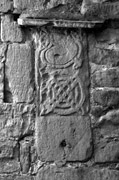
Object type: Part of a cross-shaft
Measurements: H. 73 cm (28.5 in); W. 30 > 28 cm (11.75 > 11 in); D. unknown
Stone type: Pale red (5YR 6/2), moderately sorted, clast-supported, medium-grained, quartz sandstone. Grain size of the sub-angular to sub-rounded clasts varies from 0.2 to 0.4 mm, but dominantly they are 0.3 mm across. Helsby Sandstone Formation, Sherwood Sandstone Group, Triassic (C.R.B.)
Plate numbers in printed volume: Ill. 5
Corpus volume reference: Vol 13 p. 104-105
(There may be more views or larger images available for this item. Click on the thumbnail image to view.)
This appears to be a fragment of a cross-shaft carved in shallow relief. A thin, flat-banded edge moulding survives on the left-hand side; that on the right has been broken away.
A (broad): The decoration consists of a truncated zoomorph set above a closed interlace pattern. The uppermost part of the animal form is missing, but the lower part curls behind itself to end in some form of appendage, perhaps a tail. The outside of the serpentine body is wrapped in what appears to be a strand of interlace. To the upper left of the beast is a small interlace knot which appears to extend from the head or neck of the zoomorph. A small front leg appears to emerge from the body on the left-hand side and rest on the closed interlace below. This consists of three concentric circles and two diagonal loops (closed circuit pattern B: Cramp 1991, fig. 24). The lower portion of the fragment is plain and appears to have been left undecorated, suggesting that this may have originally formed the base, or part of the base, of a free-standing shaft.
Of particular interest is the reuse and display of this stone within the exterior quoins of the pre-Conquest building, the only fabric from this period extant in the church. It strongly suggests that the cross-shaft had, by the late-Saxon period, lost its original context as a free-standing monument and was now part of a different monumental display as part of the church building. However, it is notable that there seems to have been no attempt to hide this fragment, suggesting the deliberate presentation of spolia. The style of the zoomorph in the upper part of the stone, with its distinctive serpentine shape, resembles that of the Anglo-Scandinavian ‘Jellinge beast’ generally associated with a tenth-century date. Other examples survive at Spondon (1), a few kilometres north of Aston, and at Breedon-on-the-Hill and Asfordby in Leicestershire (Sidebottom 1994, 219, 233, Appendix 3B). In all these cases, the animal forms intertwine with interlace in numerous and diverse ways, a tendency particularly prevalent in this region of the Trent Valley basin. Although the creature at Spondon is now badly degraded, a rubbing by Browne (1886) shows a similar arrangement of interlace and thicker strands which may have been part of a zoomorph (Ill. 408). The closed interlace pattern below the zoomorph is also represented elsewhere in this region: at Ilam (1) in Staffordshire, as well as Lockington, Leicestershire (Sidebottom 1994, 257-8, Appendix 3B), and Stapleford in Nottinghamshire (Everson and Stocker 2015, 188-95).
