Select a site alphabetically from the choices shown in the box below. Alternatively, browse sculptural examples using the Forward/Back buttons.
Chapters for this volume, along with copies of original in-text images, are available here.


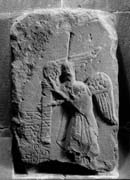
Object type: Architectural fragment
Measurements: H. 33.2 cm (13 in); W. 22 cm (8.5 in); D. (after Phelps 1905, 173) 14 < 19 cm (5.5 < 7 in)
Stone type: Pale yellowish brown (10YR 6/2), hard, non-calcareous, medium-grained (0.2 to 0.4 mm, with a few grains up to 0.8 mm), clast-supported, quartz sandstone. The grains, which are mostly quartz, vary from sub-angular to sub-rounded; a few scattered fragments of white mica. ?Collyhurst Sandstone, Permian
Plate numbers in printed volume: Ills. 732-4
Corpus volume reference: Vol 9 p. 264-5
(There may be more views or larger images available for this item. Click on the thumbnail image to view.)
The sole visible face shows an angel holding a scroll with an inscription (partly on the scroll and partly on the surrounding ground).
Inscription The roman-script inscription is read by Okasha (1971, 100):
The letters AN on the first line are ligatured.
Appendix A item (stones dating from Saxo-Norman overlap period or of uncertain date)
Though frequently assigned to the pre-Norman period, Coatsworth's study clearly demonstrates that this carving is of Norman date (Coatsworth 1983).
Inscription Okasha (1971, 100) interprets the text as In manus tuas D(o)m(in)e comme(n)do sp(iritum) 'Into thy hands, O Lord, I commend (?my) spirit', probably echoing the Vulgate Psalm XXX, 6 and Luke XXIII, 46. She observes that the script 'is rather odd and could perhaps be post-Conquest', suggesting that it might not be primary. The re-dating of the carving to the Norman period relieves this tension.
