Select a site alphabetically from the choices shown in the box below. Alternatively, browse sculptural examples using the Forward/Back buttons.
Chapters for this volume, along with copies of original in-text images, are available here.


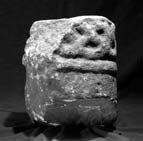
Object type: Part of round-shaft [1]
Measurements: H. 31 cm (12.25 in); Circumference 83 cm (32.75 in)
Stone type: Pale yellowish brown (10Y/R 6/2), medium-grained (0.4 mm) to very coarse-grained (1.5 mm), but mostly coarse-grained in the range 0.6 to 0.8 mm; angular to sub-angular (some grains sub-rounded), clast-supported, quartz sandstone. Millstone Grit Group, Carboniferous
Plate numbers in printed volume: Ills. 189-94
Corpus volume reference: Vol 9 p. 84
(There may be more views or larger images available for this item. Click on the thumbnail image to view.)
With the exception of the damaged area, the fragment is near-cylindrical in section. Towards the top of the piece is a horizontal roll moulding and above this is knotwork in relief running horizontally around the shaft. The pattern appears to be essentially a three-strand plait with two confronted pattern D knots, but this takes on zoomorphic elements — there appear to be two adjacent loose ends/tails in the middle of one knot and an expansion of the strand to accommodate an oval eye at another point.
Round-shaft (see Chapter V, p. 33, and Macclesfield 3 above). The junction with the (now lost) rectangular section was marked by a broad and bordered collar of interlace. Within the Peak District series this ornamental organisation is closely paralleled at Leek and Chebsey in Staffordshire, as well as more distantly at Penrith in Cumberland (Brown, G. 1937, pl. XCVIII; Pape 1945–6, 32; Bailey and Cramp 1988, 135–7). Astbury 1 and Disley Lyme Handley 1 and 2 offer local parallels for the broad collar, though using scroll decoration (Ills. 20–2, 162–70). If the interlace is zoomorphic then it would be perfectly consistent with the Viking-age date proposed for this type of carving.
