Select a site alphabetically from the choices shown in the box below. Alternatively, browse sculptural examples using the Forward/Back buttons.
Chapters for this volume, along with copies of original in-text images, are available here.


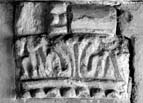
Object type: Impost fragment
Measurements: H. 19 cm (7.5 in); W. 35 > 33.5 cm (13.7 > 13.2 in); D. Built in
Stone type: Pale brownish-yellow (10YR 8/4–6) oolite, with a powdery surface coating. Bath stone
Plate numbers in printed volume: Pl. 396
Corpus volume reference: Vol 7 p. 201
(There may be more views or larger images available for this item. Click on the thumbnail image to view.)
Only one face is visible. A band of stiffleafed acanthus set above a curving, bold roll-moulding with a row of pellets below (depth of carving 2 cm).
The very slight curve on this piece seems to suggest that it is an impost rather than a capital. The fragment with pellets set into the wall above (Avebury 3) could be part of the same feature, and suggests that the pelleted base was enclosed within a double band. It finds its closest parallel in an impost fragment from Peterborough Cathedral in which only the band of acanthus-type ornament survives (West 1993, 254, fig. 6). This piece has clearly been influenced by 'Winchester' art, and its rather hesitant foliage is a form of acanthus. This stiffleaf type is however more like Carolingian work (see a mount from Wareham, Dorset: Webster and Backhouse 1991, 280, cat. 256) than the freer leaf forms in the capitals of Anglo-Saxon manuscripts, such as the Benedictional of St æthelwold, but it is closely similar to the acanthus in the rectilinear panels which frame some of the scenes in that manuscript (see Temple 1976, ill. 88). In a longer account of the Peterborough fragment, West separates it clearly from the mid to late eleventh-century work at Bibury or Milborne Port and dates it to the late tenth or early eleventh century (1993, 256). This piece is formal and ordered and the earlier date is to be preferred.
