Select a site alphabetically from the choices shown in the box below. Alternatively, browse sculptural examples using the Forward/Back buttons.
Chapters for this volume, along with copies of original in-text images, are available here.


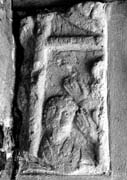
Object type: Fragment
Measurements: H. 30 cm (11.9 in); W. 17.5 cm (6.9 in); D. Built in
Stone type: Pale yellow (2.5Y 8/4) even-grained oolite with a calcite matrix, its surface showing vacated sockets of ooliths, 0.3 to 0.5mm in diameter. Bath stone, Chalfield Oolite Formation, Great Oolite Group, Middle Jurassic
Plate numbers in printed volume: Pls. 393-4
Corpus volume reference: Vol 7 p. 200-1
(There may be more views or larger images available for this item. Click on the thumbnail image to view.)
Part of a wall panel or cross-shaft. The face is divided into two panels, and there appears to have been a double roll moulding on the sides. In the top panel is what may be a strand of interlace, but it appears rather thick and the worn elements above could be feet which are standing on the 'strand'. In the panel below are parts of two figures, the lower with short curly hair, drilled eyes, and possibly a beard. The folds of the drapery of his clothing are very sketchily conveyed. His head is bent back, looking up at the figure on his left. Only the two extended hands and part of the head of this figure survive. The right hand is held above the head of the other figure and the left is touching the side of his face, perhaps his ear.
The church is situated immediately west of the Neolithic enclosure and on royal land and on an important routeway (Pelteret 1985; Pollard and Reynolds 2002, 224–6, fig. 103), as well as being next to the manor which dates back to at least the twelfth century (Pollard and Reynolds 2002, 218, 220, 247). It has been variously considered as a minster, possibly linked to Malmesbury, or as a manorial church (ibid. 207–9; Blair 1985, 108, fig. 7.1), but whichever its status, its location and scale make it one of the most important surviving Anglo-Saxon churches in Wiltshire.
This piece could indeed be part of the decoration of the early church. It was seen by King (1884, 397) as a representation of the Heavenly Father giving benediction to the Son, who is embracing the cross'. Alternatively, it may be part of a miracle scene in which a deaf person or deaf mute is being healed. There is no close comparison for the style of the lower figure, although it bears some relationship to the figure in the plant-scroll on a fragment from Reculver, Kent, which has the same bulging cheeks, drilled eyes and treatment of the hair (Tweddle et al. 1995, ills. 119–20). Since so little is left of the figure with extended hands, it is impossible to say whether this was Christ, God the Father, or a lesser figure.
