Select a site alphabetically from the choices shown in the box below. Alternatively, browse sculptural examples using the Forward/Back buttons.
Chapters for this volume, along with copies of original in-text images, are available here.


Object type: Grave-cover
Measurements: Not known
Stone type: Not known
Plate numbers in printed volume: Ills. 147-8
Corpus volume reference: Vol 12 p. 200
(There may be more views or larger images available for this item. Click on the thumbnail image to view.)
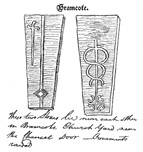
One of the grave-covers drawn by Stretton has a 'bracelet-headed' cross at its 'foot' end and additional bands added to the centre of the ridge rib. A cross is probably missing from the head end, and it is of later medieval date.
But the left-hand of the two grave-covers illustrated shows a tapered cover missing only the uppermost parts, that is its 'head' end (Robertson 1910, 33). As depicted, the upper surface of this cover is decorated with a bold raised fillet running centrally along the monument. Towards its 'foot' end, Stretton clearly shows a boldly projecting raised lozenge of at least three concentric orders. As drawn, it is very similar to the decoration on the monument at West Leake 1 (see below, p. 205), which, however, is complete and has a second lozenge placed symmetrically at the head end to balance that at the foot (Ills. 161–2). On the basis of this parallel, it is likely that the Bramcote example also had such a lozenge at the head end, which had been damaged by the time Stretton saw it. The head end of the cover had been deliberately removed during a phase of reuse. To the left of the central rib (when viewed from the 'foot' end) Stretton also shows the incised outline of a sword with its hilt upwards. The sword shown has a curved grip without an enlarged pommel and 'recurved' cross-guards.
Appendix A item (stones dating from Saxo-Norman overlap period or of uncertain date)
The detailed depiction of the sword in Stretton's drawing suggests that this stone might have been reused for a second graveyard monument, once it was redundant in its original role. There are two reasons for thinking the outline of the sword a much later addition to the stone. First, we can date the original stone to the later eleventh century (below), whereas according to most typologies (e.g. Butler 1964) examples of the depiction of weapons on grave-covers do not occur until at least a century later. But secondly, the type of sword represented at Bramcote is not of a convincing early medieval design. The curved grip and the 'recurved' cross-guard do not occur in western European weapons until the later fifteenth century, and they do not become the norm until the sixteenth century (Hayward 1963, nos. 11, 40–1; Oakeshott 1997, 127). It seems likely, therefore, that the sword was added to the stone during a secondary use as a graveyard monument, perhaps in the fifteenth or sixteenth century.
The original decoration of the monument, with its central rib and bold lozenge(s) is very similar to the monument at West Leake 1 (p. 205, Ills. 160–2). In adopting the lozenge — possibly in place of a crossbar — both of these Nottinghamshire monuments can be associated with a number of examples in Cambridgeshire and the Soke of Peterborough, and with the Lincolnshire monuments at Crowland Abbey 1 and Sleaford 3 (Everson and Stocker 1999, 146, 290, ills. 143, 429). Lawrence Butler allocated a date in the late eleventh century to some of the more southerly members of this group (1957; 1964, 118–21), and it is even possible that the example from Crowland is pre-Conquest in date (Everson and Stocker 1999, 146). Butler suggested that the 'lozenge' detail was a distinctive feature of grave-covers from the Barnack group of quarries, but the example at Sleaford is from the Ancaster area, demonstrating that the motif was in use at more than one East Midland production centre. Significantly, the West Leake example (only some six miles to the south of Bramcote) is not made from Barnack stone, but of a local Permian limestone; and it therefore seems probable that Bramcote 1 was also likely to have been in a local stone, emulating a prestigious form of monument, rather than an original Barnack product. Several of the other covers incorporating 'lozenges' also have additional ornamentation to the ridge rib, and the fact that the rib at Bramcote is otherwise plain might suggest that it belongs relatively late in the series.
