Select a site alphabetically from the choices shown in the box below. Alternatively, browse sculptural examples using the Forward/Back buttons.
Chapters for this volume, along with copies of original in-text images, are available here.


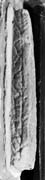
Object type: Part of shaft [1]
Measurements: H. 59 cm (23.4 in); W. 16 cm (6.6 in); D. 8 cm (3.6 in)
Stone type: Greyish orange (10YR 7/4), well sorted, clast-supported, quartz sandstone. The sub-rounded clasts range from fine-grained (0.2 mm) to medium-grained (0.4 mm), but are mostly medium-grained at 0.3 mm. ?Cocklett Scar Sandstone Member, Roeburndale Formation, Millstone Grit, Carboniferous
Plate numbers in printed volume: Ills. 625-6
Corpus volume reference: Vol 9 p. 234
(There may be more views or larger images available for this item. Click on the thumbnail image to view.)
A single roll-moulding border survives between the two faces.
A (broad): At the bottom of the shaft is part of a ring-knot with three concentric rings, the middle one formed by a line of pellets, each with a drilled hole; the strands are median-incised. The angular turn in the upper left corner of the knot sprouts a spiral offshoot. Above this is irregular knotwork with pellets between the strands. One of the strands has a lobed turn.
B (narrow) and C (broad): Lost
D (narrow): Collingwood (1927a, fig. 179) restored this ornament as a ring-chain of type Cv (see Cramp 1991, fig. 26); the surviving remains do not convincingly support this restoration.
The close relationship between this shaft and Lancaster St Mary 4 has been discussed above (p. 222, Ills. 581, 626). Both Lancashire carvings are related to material from Aspatria and other sites on the Cumberland coastal plain (Bailey and Cramp 1988, 51, ill. 31).
