Select a site alphabetically from the choices shown in the box below. Alternatively, browse sculptural examples using the Forward/Back buttons.
Chapters for this volume, along with copies of original in-text images, are available here.


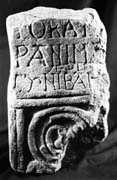
Object type: Shaft and lower arm of cross
Measurements: H. 41 cm (16 in); W. 27 > 25 cm (10.5 > 9.75 in); D. 13.5 > 12 cm (5.25 > 4.75 in)
Stone type: Greyish orange pink (5YR 7/2), poorly sorted, clast-supported, quartz sandstone. The sub-rounded clasts range from 0.2 to 1.5 mm, but are mostly 0.3 to 0.6 mm. A few scattered flakes of white mica up to 2 mm. Millstone Grit, Carboniferous
Plate numbers in printed volume: Ills. 603-10
Corpus volume reference: Vol 9 p. 230-2
(There may be more views or larger images available for this item. Click on the thumbnail image to view.)
A (broad): This face carries part of a shaft-panel, flanked to the left by a double roll-moulding border and topped by a single moulding. Above this, the curved outline of the stone to the left indicates that the upper section of the fragment formed part of the lower arm of the cross-head. (i) The head section has no visible border but carries a text in Latin capitals which is described below. (ii) Below, on the shaft, is one spiral of a single-stemmed scroll terminating in a berry bunch. There is an angled stem in the lower left corner.
B (narrow): Only the horizontal roll moulding to separate head and shaft remains from the framing of this face. (i) In the head is an inscription in Latin capitals which is described below. (ii) Below, on the shaft, is one spiral of a scroll with no evidence of fruit or foliate elements.
C (broad): As on face A, part of the upper shaft and lower head survive on this side. The shaft ornament is flanked by a double roll-moulding border to the right and topped by a single horizontal moulding. (i) The head, whose worn curved outline (lacking borders) survives to the right, carries an inscription in Latin capitals which is described below. (ii) Below, on the shaft, is the top of an elaborate medallion from a double-stemmed scroll. At the centre is an oval or long triangular berry bunch enclosed within two stems. To the right are two enclosing further stems, the inner curling round the outer in the upper corner of the panel.
D (narrow): A single roll-moulding border survives on both sides of the shaft together with the horizontal moulding separating shaft and head. (i) There is no border moulding on the head which carries an inscription in Latin capitals which is described below. (ii) Below, on the shaft, is one spiral from a single-stemmed spiral scroll with a triangular drop leaf terminal emerging below the spiral. There are traces of a further spiral with a similar leaf, this time pointing upwards, in the lower left corner of the surviving fragment.
Inscription The roman-script inscription is neatly laid out and spaced in three lines on each face of the stone. It apparently reads anti-clockwise:
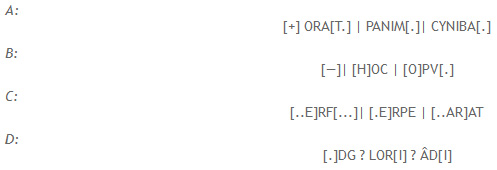
Damage to the edges, and at some points to the faces of the stone, accounts for the extent of loss indicated here. Between the second and third lines of face A some text is set in very small letters. This text is difficult to read. Okasha (1971, 90) read DED, following two unidentified letters. Edwards (1966, 147) read a ligature representing ET (which seems to be equivalent to the second, but not the first, of Okasha's unidentified characters), followed by PE (this part equating, apparently, to Okasha's initial DE).
On face A the BA of CYNIBA[.] are ligatured.
This fragment is typical of Lune valley scrolls and, in its inscription, also characteristic of the literacy of many of the monuments in Lancaster and its immediate area (see Chapter IV, p. 20). Cramp (in Edwards, B. 1966, 148) rightly noted that the development of full-length scroll panels reaches back to Hexham but the specific composition seen here is typical of south Cumbria and north Lancashire; the combination of (a) a broad face with double scroll and (b) a second face with a tightly-wound spiral scroll centering on a fruit cluster, together with (c) two more trail-like scrolls is one which is found (probably earlier) at both Lowther and Heversham (Bailey and Cramp 1988, ills. 351–4, 440–3), and repeated locally on Lancaster St Mary 3 (Ills. 577–80). In addition, though a double arris is usually a marker of ambitious work, it is probably significant that the combination of single and double arrises seen here is also found on Lancaster St Mary 2 and 3 (Ills. 568–76, 577–80). The former cross also provides the best parallel for the delicate twisted terminations of the stems at the top of the panel on face C — though on Lancaster 3 these top a panel of single scroll and both look back ultimately to Hexham models (e.g. Cramp 1984, pl. 180.965). The fruitless scrolls with dropped leaves found on the narrow edges are also found on Lancaster 3 and on Heysham 1 and 2 (Ills. 510, 512).
The positioning of the inscription differs from the convention observed on Lancaster St Mary 1 and 2 where they are placed at the top of the shaft; set on the head it can be paralleled at Bewcastle, Dewsbury, Carlisle and Whitby (Higgitt 1986b, 130).
Inscription The inscription clearly begins + Orat[e] p(ro) anim[a] Cyniba - 'Pray for the soul of Cyniba-'; cf. Lancaster St Mary 2. The small text between lines two and three looks like an insertion, and — although they differ markedly in their readings (see above) — Okasha (1971, 90) and Edwards (1966, 148) agree that it may represent a later addition of a second personal name; certainly the positioning supports this possibility. Edwards argued that the text reads et p(ro) E-.
The commemorated person may well have been a man with the recorded Old English name Cynebald. Both Okasha and Edwards suggest that there is insufficient room for final -LD, and speculate on a less usual *Cynebad. In fact, it is not entirely clear that there is not enough room: the single surviving upright of the letter after A is in line with the T of the first row, after which we certainly expect an E; if the upright in the third line was that of L, a following D would have been in line with this E.
The last face of the inscription, if correctly interpreted, is also reasonably clear. Face D reads [A]d gloria(m) D(omi)ni 'to the glory of the Lord'. The section of text in between, on faces B and C, is more damaged, less formulaic, and less clear. Edwards (1966, 148) proposed the following reconstruction: [qui] hoc opus [p]er f [ilium p]erpe [tu]arat, translating the whole 'Pray for the soul of Cynibad, who had promised (that) this work (should be made) through his son to the glory of the Lord'. Alternatively, he suggested in a footnote (ibid., n. 7) that [p]erf [ici p]erpe [tr]abat — reading B for the letter otherwise read as damaged R — would mean something like 'C., who brought about the completion of this work to the glory of the Lord.'
Although the details cannot be certain, the inscription does appear to state that the monument was commissioned or erected to the glory of God. Higgitt (1986b, 134) suggests that 'This appears to be the clearest statement of a votive intention on the part of the patron of the cross. The cross is offered to God as a visible prayer'.
