Volume 9: Cheshire and Lancashire
Select a site alphabetically from the choices shown in the box below. Alternatively, browse sculptural examples using the Forward/Back buttons.
Chapters for this volume, along with copies of original in-text images, are available here.
Current Display: Hilbre Island 1, Cheshire


Overview
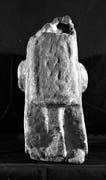
Object type: Part of cross-head [1]
Measurements: H. 38 cm (15 in); W. 51 cm (20 in); D. 15 cm (6 in)
Stone type: Greyish orange-pink (5YR 7/2) on fresh surface, weathered to pale brown (5YR 5/2), medium- to coarse-grained (0.3 to 1.0 mm, but mostly medium-grained in the range 0.4 to 0.5 mm), sub-angular to sub-rounded, clast-supported, quartz sandstone. Bedding parallel to surface. Chester Pebble Beds Formation?, Sherwood Sandstone Group, Triassic
Plate numbers in printed volume: Ills. 172-5
Corpus volume reference: Vol 9 p. 81
(There may be more views or larger images available for this item. Click on the thumbnail image to view.)
National Grid Reference of Place of Discovery
SJ 184879
Present Location
Grosvenor Museum, Chester (acc. no. 1936.546)
Evidence for Discovery
Found in either 1852 or 1853 by Mr Barton ((—) 1854b, 19), though Ecroyd Smith was later to claim that it was 'discovered by the late Mr Thomas Hughes, keeper of the telegraph station' (Smith, H. E. 1865, 273). After a period in the Dock Office at the Customs House it passed into Canon Hume's possession (Hume 1863b). Chester Museum's record card states that it was 'acquired from representatives of the late Dean Howson [in] 1886 for the archaeology society collection, formerly in Canon Hume's possession'.
Church Dedication
Present Condition
Upper part of head now lost; heavily worn on face B
Description
Lower part of circle-head, with unpierced spandrels and with small fragment of top of shaft; cross type B10
A (broad): The circle carries a type 2 meander pattern around the ring, bordered by a roll moulding. The spandrels are not pierced but carry small bosses in the armpits. At the centre is a flat boss, with a pierced central hole. Triquetra fill the surviving left and lower arms which are flanked by border mouldings.
B (narrow): No decoration visible
C (broad): As face A
D (narrow): A roll-moulding frame survives on the end of the arm; within are traces of linked triquetra.
Discussion
Circle-head (see Chapter V, p. 31). The ornamental repertoire of armpit bosses, pierced central boss and triquetra is repeated elsewhere in the group (cf. Ills. 75–99). The main distinction from the rest of the Cheshire circle-head series is that the circle is decorated with a Viking-period meander pattern.
Date
Tenth or eleventh century
References
(—) 1854b, 19–20; Hume 1863a, 267, fig.; Hume 1863b, fig. on 232; Smith, H. E. 1865, 273; Smith, H. E. 1870, 271; Smith, H. E. 1871a, 41, 42; Smith, H. E. 1871c, 31, 32, pl. facing 32; Ormerod 1875–82, II, 502; Browne 1887b, 148; Jackson 1889, 37; (—) 1891b, 119; Allen 1894, 4, 9; Allen 1895, 135, 143–4; Cox, E. 1895, 243; Collingwood 1926a, 329; Collingwood 1926b, 378; Collingwood 1928, 12, 15 and fig. 1 on 13; Sylvester and Nulty 1958, 14; Bu'lock 1959, 6, 10; Pevsner and Hubbard 1971, 380; Bu'lock 1972, 82, pl. 19; Chitty 1978, 8; Lander 1980, 3; Craggs, J. 1982, 9–11; Thacker 1987, 279, 289; Gelling 1992, 187; Griffiths 1992, 68; Griffiths 1996, 53; Austin 1999, 81; Jesch 2000a, 9; Craggs, S. 2005, 22–3, fig. 5; Griffiths et al. 2007, 370, 404
Endnotes
[1] The following is an unpublished manuscript reference to the Hilbre Island stones: BL Add. MS 37547, item 704 (Romilly Allen collection).