Select a site alphabetically from the choices shown in the box below. Alternatively, browse sculptural examples using the Forward/Back buttons.
Chapters for this volume, along with copies of original in-text images, are available here.


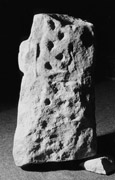
Object type: Upper section of round-shaft? [1]
Measurements: H. 50 cm (19.6 in); W. 23 > 18 cm (9 > 7 in); D. 22 > 17 cm (8.6 > 6.6 in)
Stone type: Medium grained, reddish-brown (2.5YR 5/4), feldspathic sandstone with haematite specks visible. Namurian sandstone consistent with Roaches or Ashover Grit, Marsden Formation, Millstone Grit Group, Carboniferous (R.T.)
Plate numbers in printed volume: Ills. 510–13
Corpus volume reference: Vol 13 p. 271-2
(There may be more views or larger images available for this item. Click on the thumbnail image to view.)
A (broad): This face is decorated with what appears to be a four-strand simple interlace pattern, the lower part of which is badly damaged, seemingly through dressing-off, but it is clear that the pattern continued downwards. Any edge moulding has been broken away.
B (narrow): Badly damaged but appears to have been decorated with a three-strand simple interlace. The upper part is now almost indistinguishable and any edge moulding has been broken away.
C (broad): Broken away except for the upper 20% or so where it appears to have been decorated with a four-strand simple interlace, similar to that on A. Any edge moulding has been broken away.
D (narrow): Decorated with a turned interlace pattern on the lower 60% or so. The pattern is incomplete but appears to have been composed from two strands and may have been irregular. It seems to terminate at the top in closed loops. Above, a plain square boss, extending the full width of the face, protrudes about 3 cm (1.2 in) from the surface; it appears to be broken at the top. Any edge moulding has been broken away.
Probably part of a cross-shaft (or possibly the upper section of a round-shaft cross, although there are no clear indications that this was so). Pape (1945-6, 29) describes the piece as unfinished, drawing attention to the protruding boss on D. At the corresponding point on B the decoration extends over the area, implying that the boss was not the stub of a cross-arm, but as a decorative element this would be unique in the region; this suggests that Pape may well be right in his diagnosis. He added that it was likely that the monument was made on site; as Alstonefield 6 may also be an unfinished piece, this would lend support to Pape’s argument.
The remainder of the decoration is fragmentary and, therefore, difficult to compare with other pieces either at Alstonefield or elsewhere. However, the turned pattern on D, although unusual for this location, can be compared with others in the region, for example, at Ashbourne (1), in Derbyshire (Ill. 3), about 12 km down the Dove Valley.
