Select a site alphabetically from the choices shown in the box below. Alternatively, browse sculptural examples using the Forward/Back buttons.
Chapters for this volume, along with copies of original in-text images, are available here.


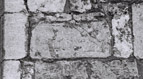
Object type: Part of grave-marker
Measurements: L. c. 25 cm (9.8 in); W. c. 54 cm (21.25 in); D. Built in
Stone type: Limestone, pale yellow, finely crystalline, dolomitic. Upper Permian, Cadeby Formation, Magnesian Limestone
Plate numbers in printed volume: Ills. 3-4
Corpus volume reference: Vol 12 p. 93-4
(There may be more views or larger images available for this item. Click on the thumbnail image to view.)
This stone represents the upper third of a rectangular marker. Originally, it would have stood perhaps one metre tall, although when in situ at least half of it would have been buried in the ground. The part projecting above the ground in this case is decorated with simple incised decoration. The borders of the decorated face are outlined by a simple broad fillet of square section, and the field created is divided into two panels by a fillet of similar width. The left-hand of the two panels is decorated with a simple, incised, broad cross-saltire with one arm crossing over the other. The signs are that there was an exactly equivalent cross in the right-hand field, and two slightly incised lines of one arm survive in the lower right-hand corner. This side of the stone has been crudely trimmed back with a broad-bladed tool using a diagonal technique, however, perhaps during an earlier phase of reuse.
The grave-marker represented by Carlton-in-Lindrick 1 is of a quite well-recognised type in the East Midlands. In Lincolnshire a group of fifteen examples of rectangular markers of this general type have been catalogued, as 'Lindsey markers' and their derivatives (Everson and Stocker 1999, 60–1, table 7A). Cruder examples akin to that at Carlton, of which six Lincolnshire examples were catalogued, were christened 'gridded markers', and in the discussion of that group attention was drawn to a further six examples in Leicestershire, Rutland and the Soke of Peterborough (ibid., 62, table 7B). All of these 'gridded markers', it was argued, represented essentially crude and late variations of the more carefully carved 'Lindsey markers', which were the dominant form of grave-marker in this part of Lincolnshire from the late tenth until the mid eleventh century, or even later. More recently, a further five broadly similar monuments have been discovered at Peterborough Abbey, some of which might belong to an immediately post-Conquest context (Hall, J. 2008, 19–20). Hall offers evidence that such monuments marked the graves of the local elite (at Peterborough Abbey anyway), and associates them both with a group of traders at the abbey and with a number of impoverished knights known to have been buried there before 1116. The crosses on many members of the Lincolnshire 'gridded marker' series, as well as on all of those from Leicestershire, Rutland and Peterborough, are cut with a single incision, however, and it is tempting, therefore, to place examples such as Wilsford 2 in Lincolnshire (Everson and Stocker 1999, 273, ills. 390–1) and Carlton-in-Lindrick 1 — on which the crosses are outlined with double lines — somewhat earlier in the series; probably before the Conquest in absolute date.
One of the most signal characteristics of the 'gridded marker' group is that they appear to have been carved to a very similar formula in several different Jurassic limestone quarries (the Ancaster and Clipsham and Barnack quarry zones). The example from Carlton extends the list of quarry zones known to be producing monuments of this type into Pennine geology. Although the design it bears is quite different, Carlton appears to be cut from the same stone as the rectangular marker from Church Warsop (Church Warsop 1 below, Ill. 6), perhaps demonstrating an extended tradition of marker production in these quarries.
